Listen to this article here
There are lots of cars that define Britain. The Mini, the Escort, the battered white Transit van and the London black cab. Then somewhere in the middle of all these sits the Vauxhall Corsa. It's not glamorous, nor is it exotic. It's not fast either unless you dropped it from a helicopter. But even so, no matter where you go in this country, you’re bound to see at least one Corsa.
Visit any local town, and you’re guaranteed to see a faded blue Corsa being driven by Doris as she peers over the steering wheel like she’s commanding HMS Queen Elizabeth down the Sharpness Canal. Or visit a McDonald’s car park at 10pm, and there’s bound to be a modified Corsa covered in Halfords accessories, with a dustbin-sized exhaust pipe making more noise than Brian Blessed mid-climax and enough bass coming from the boot to register on seismographs in Japan.
The Corsa is a car that appealed to everyone. Teenagers loved it because insurance companies hadn’t yet realised that putting a 17-year-old in a 1.2 SXi with a cherry bomb exhaust was effectively giving them the ability to try and be the next Mika Häkkinen around their local B&Q car park. Older people loved it because it was small and easy to park when popping to the local shops to pick up a paper and some milk for elevenses. Families loved it too, because it had space for five people, as well as space in the boot for a pushchair and shopping whilst still being small enough to easily get around towns and cities.
The Corsa story begins, once upon a time in 1993, with the launch of the Corsa B. Vauxhall had taken the humble supermini and dragged it into the modern world. Suddenly power steering and ABS all came as standard. Then came the Corsa C in 2000. Now this was important because the Corsa C arrived at exactly the right moment, bringing new ideas to a new millennium. You see Britain was changing. Mobile phones were becoming normal. Everyone had frosted tips, and "Can We Fix It?" by Bob the Builder was the UK’s top-selling single. And Vauxhall released a car that looked modern and appealed to everyone. Then as the Corsa evolved, the engines grew larger too, ranging all the way up to the 1.8-litre SXi, which, at the time, must have felt like a rocket car the size of a cardboard box. Most people sensibly chose the smaller Ecotec engines because they valued fuel economy and insurance premiums that didn’t resemble a second mortgage.
Then came the Corsa D in 2006, which arrived looking rounder, heavier and considerably more grown-up. The Corsa C bubble butt had been dialled right back. By this point the Corsa had stopped being just another car and had become a rite of passage. Half the nation learnt to drive in one, while the other half had either crashed one into a hedge or fitted an exhaust loud enough to wake everyone within a four-mile radius. Most people you meet will have some sort of story involving a Corsa at some point in their lives.
The Corsa E followed in 2014 with more technology, sharper styling and touchscreen infotainment. And now we have the latest Corsa, quieter, cleverer and available as an electric car, which means the little Vauxhall supermini that once spent its evenings outside McDonald’s car parks has all grown up and now glides around in silence.
I have a soft spot for the Corsa.
I’ve owned two: a Corsa D SXi with a 1.2-litre engine with big alloy wheels and
a black interior with red trim and bucket-style seats. In reality, though, it was about as sporty as me
in a tracksuit. My absolute favourite Corsa, however, was a tiny 2001 Corsa C
with a pixel-sized 12-valve 3-cylinder engine. Now, thanks to it only
being a 1-litre engine, it wasn’t even on talking terms with the word 'quick'. The engine only produced 58 BHP, and to measure 0-60, you'd need a calendar. But that didn’t matter because in that thing, 5 miles
an hour felt like 500. Planting your foot deep into the carpet would get an
almighty roar from the lumpy little engine block lurking under the bonnet, sounding
like some sort of V6, and not much else would happen. It drove like a go-kart
as well, just with five seats and a heater. It stuck to the road on the corners,
skipping from one corner to the next, before letting out another growl as it
tried its hardest to get back up to speed on the straights.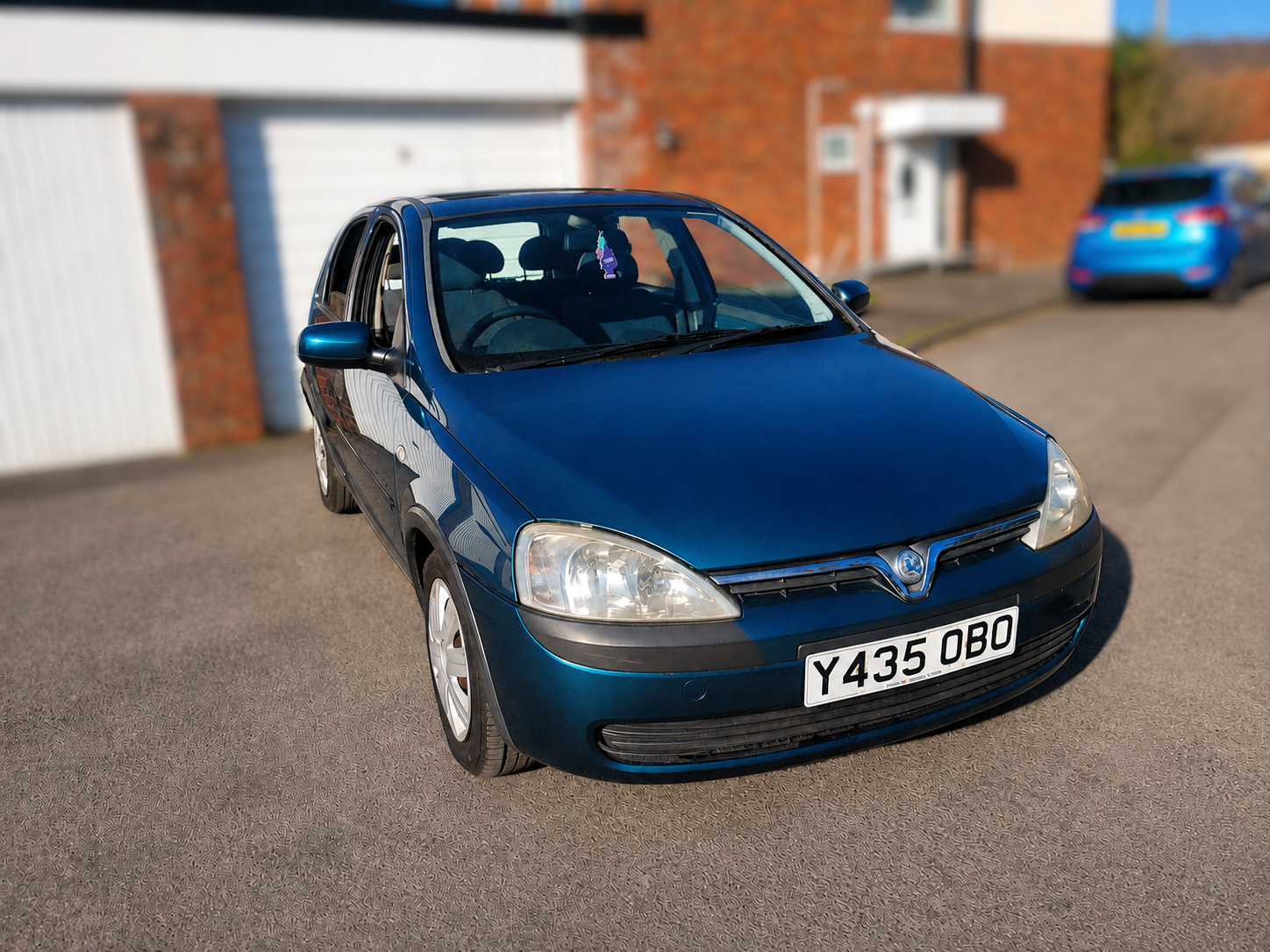
Its only real downfall was any sort of gradient. Flat roads were fine. But introduce any incline greater than the slope of a supermarket car park, and even with a run-up, by the crest you’d be gripping the steering wheel in second gear, making more noise than an Apollo launch whilst being overtaken by snails.
There were some issues with it as well, of course. Water leaked through the bulkhead seal whenever the heavens opened, leaving the footwells permanently damp between October and April and meant that on frosty mornings I’d have to scrape both sides of the windscreen.
The interior was gloriously simple as well. Three rotary knobs controlled the heating and the fans. It also had central locking, electric front windows and a cheap aftermarket stereo that made just enough noise to resemble music. While the Corsa C did have an option for aircon, it wasn’t an option that was selected on my car. But it didn’t need AC. It had a sunroof; on warm evenings you could wind it open, drop all four windows, and suddenly that humble little hatchback felt like a compact convertible sports car.
The Corsa has never tried to be special. It wasn’t engineered to set Nürburgring lap times or dominate Instagram feeds outside artisan coffee shops. It was built to start every morning, survive potholes, carry shopping, embarrass itself heroically in a car park and keep Britain moving quietly in the background. And for that reason, the Corsa will always have a special place in my heart.